
Fish species identification in NZ marine reserves involves recognizing distinct physical traits such as fin shape, coloration, and swimming patterns of native species like Snapper and Blue Maomao. Successful identification enhances the snorkeling experience by allowing visitors to distinguish between lookalike species such as Parore and Sweep in protected no-take zones.
Why Species Identification Matters in Marine Reserves
New Zealand’s marine reserves, such as the Goat Island Marine Reserve (Cape Rodney-Okakari Point) and the Poor Knights Islands, offer a window into a pristine underwater world. Unlike unprotected areas where fish may be skittish due to fishing pressure, marine reserves host populations that are often larger, older, and more curious about human visitors. Mastering fish species identification in NZ marine reserves transforms a casual swim into an educational adventure.
Understanding what you are looking at connects you deeper to the ecosystem. It allows you to appreciate the complex behaviors of marine life, from the grazing habits of urchin-eating predators to the schooling formations of planktivores. Furthermore, accurate identification helps in citizen science projects and ensures that divers and snorkelers can report unusual sightings or invasive species to the Department of Conservation (DOC).
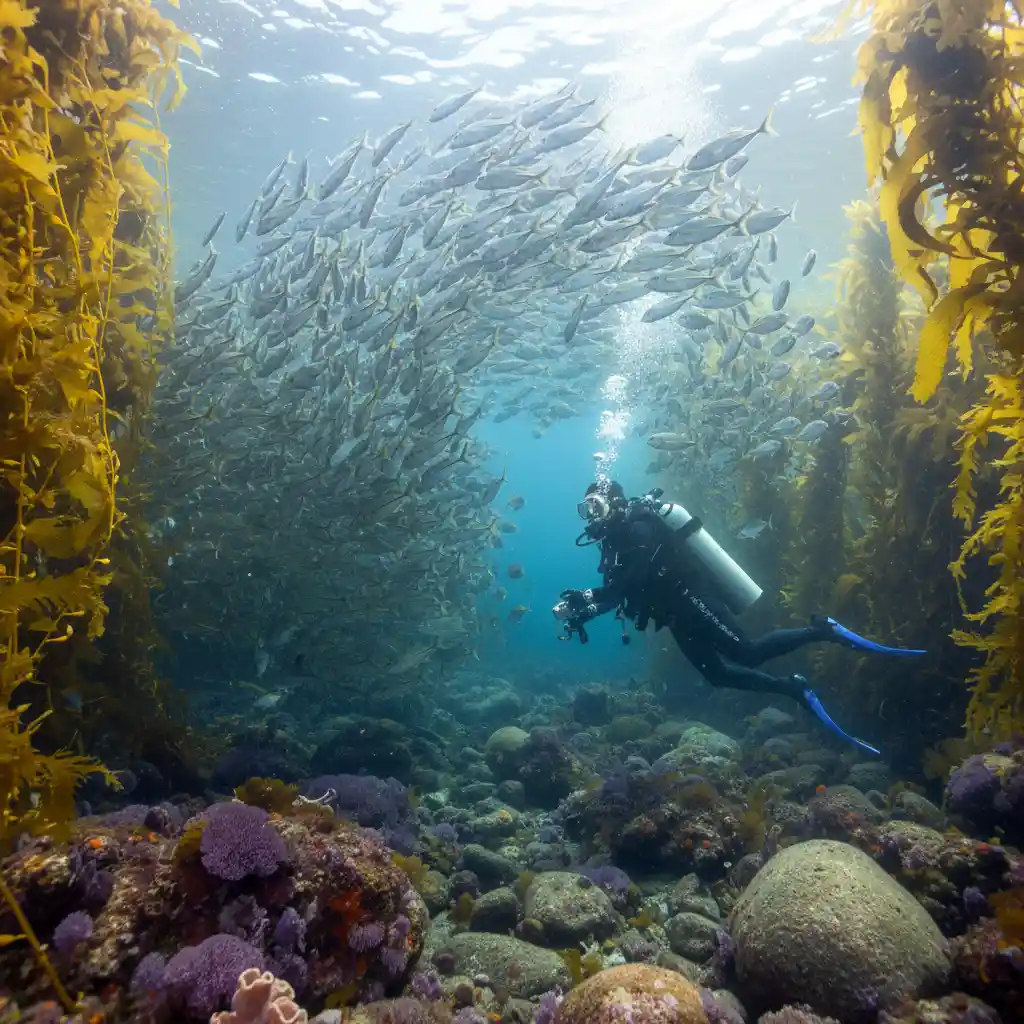
Identifying Snapper (Tamure): The King of the Reef
The Australasian Snapper (Pagrus auratus), known to Māori as Tāmure, is perhaps the most iconic inshore fish in New Zealand. In marine reserves, they behave very differently from their wild counterparts. Instead of fleeing, they often approach divers, displaying a level of confidence that makes them excellent subjects for observation.
Key Physical Characteristics
To positively identify a Snapper, look for the following traits:
- Coloration: They possess a golden-pink to metallic copper sheen on the upper body, fading to a creamy white on the underside.
- The Blue Dots: One of the most beautiful features, particularly in younger and medium-sized fish, is the scattering of electric blue spots along the upper flanks.
- Body Shape: They have a deep, laterally compressed body with a strong, arching back.
- The Hump: Large, mature adults (often found in reserves) develop a distinctive fleshy hump on the forehead and a heavy, bony ridge around the eyes.
Behavioral Cues
In reserves, Snapper are often the first fish to greet you. They are opportunistic feeders and will often trail behind stingrays or goatfish, waiting for them to disturb the sediment to reveal crustaceans. If you see a fish aggressively crunching on a sea urchin (kina), it is almost certainly a large Snapper.
Blue Maomao Schools: A Sea of Azure
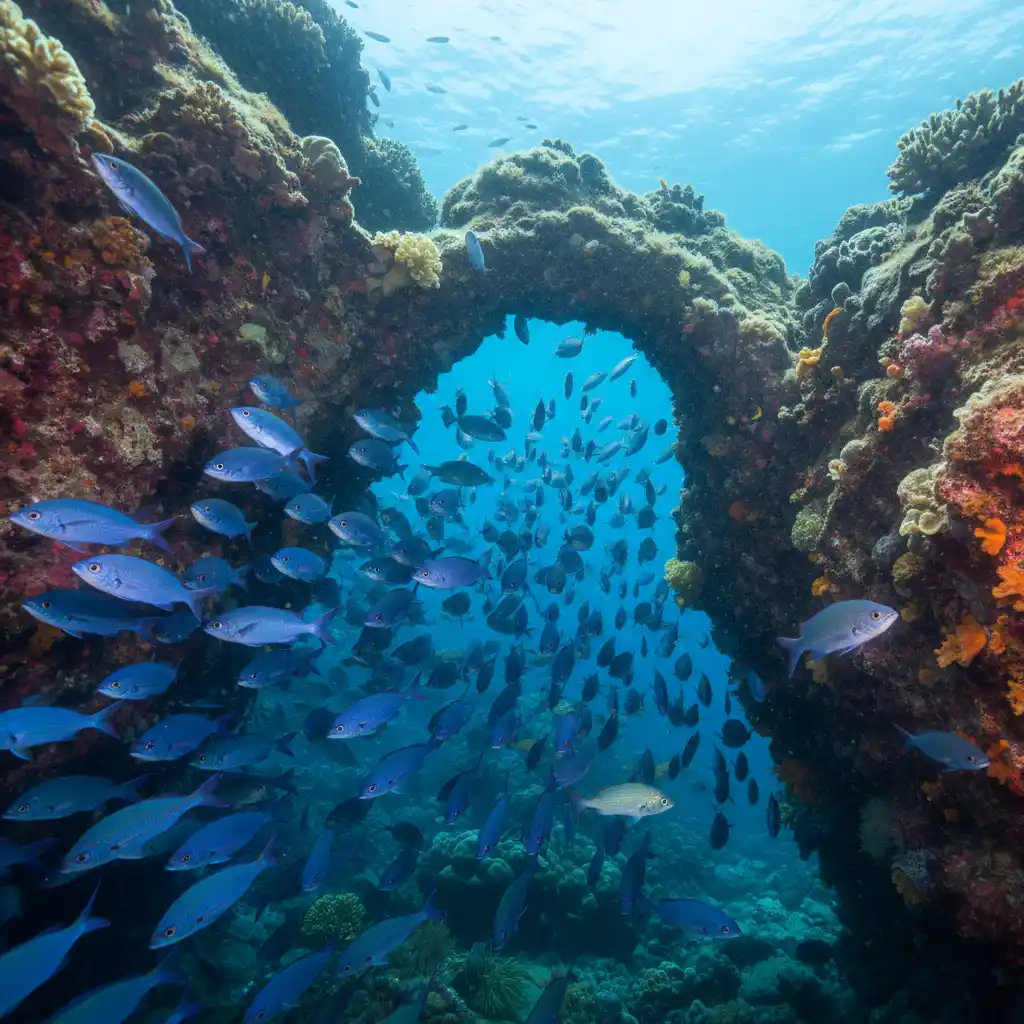
Few sights in New Zealand waters are as mesmerizing as a dense school of Blue Maomao (Scorpis violacea). These fish are synonymous with the clear waters of Northland’s marine reserves, particularly around archways and drop-offs.
Visual Identification
Blue Maomao are easily distinguished by their vibrant color, but lighting conditions can alter their appearance:
- Color: A uniform, brilliant violet-blue. Juveniles are often a brighter, electric blue, while older adults may appear slightly darker or more greyish-blue in low light.
- Shape: They have a compressed, oval-shaped body with a forked tail.
- Movement: They are almost always found in schools. Unlike solitary hunters, Maomao move in unison, creating dynamic shapes in the water column as they feed on plankton.
Habitat Preferences
You will rarely find Blue Maomao resting on the sand. They prefer current-swept rocky reefs and vertical walls where nutrient-rich water brings a constant supply of plankton. If you are swimming through a rock archway at the Poor Knights, look up; silhouetted against the surface, thousands of these fish often form a “living ceiling.”
Parore and Sweep: Spotting the Differences
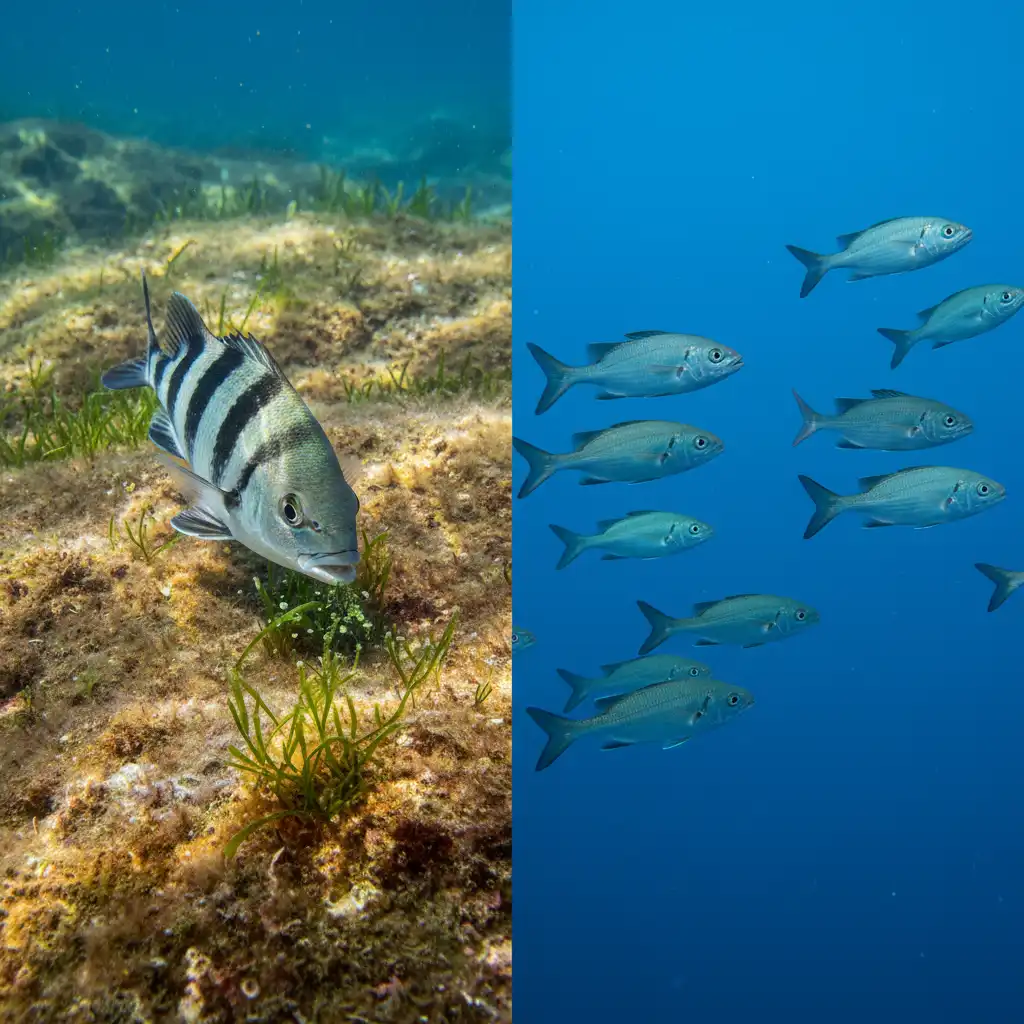
For the untrained eye, the Parore (Girella tricuspidata) and the Sweep (Scorpis lineolatas) can be difficult to distinguish. Both are common, schooling fish found in similar environments, but they have distinct differences in diet, behavior, and physical structure.
Identifying Parore (Black Bream)
The Parore is primarily a herbivore. Its identification features include:
- Stripes: The most obvious giveaway is the series of roughly 10 narrow, dark vertical bars running down the sides of its grey-brown body.
- Habitat: Parore are often found in shallower waters, grazing on algae-covered rocks or weaving through kelp forests.
- Body Shape: They are more robust and thicker-set than Sweep.
Identifying Sweep
The Sweep is closely related to the Blue Maomao and shares its plankton-feeding habits.
- Color: Silvery-grey to blue-grey, lacking the distinct vertical stripes of the Parore.
- Shape: Sweep have a more streamlined, flattened body designed for swimming in currents. Their pectoral fins are notably long and curved.
- Behavior: While Parore pick at rocks, Sweep are usually looking upwards or swimming in mid-water, snapping at passing plankton.
Spotting the Elusive John Dory (Kuparu)
The John Dory (Zeus faber) is a master of stealth and camouflage. Spotting one is a highlight for any diver or snorkeler, as they are solitary and blend seamlessly into their surroundings.
The Stalking Predator
The John Dory is unique in its morphology. It is extremely thin laterally—almost like a dinner plate turned on its side. This allows it to slowly drift toward prey head-on, appearing almost invisible until it is within striking range. When it attacks, its mouth shoots out like a telescopic tube to engulf small fish.
The Legend of the Thumbprint
The easiest way to identify a John Dory is by the large, dark circular spot in the center of its body, ringed with a yellow halo. According to legend, this is the thumbprint of St. Peter (hence the name “Peter’s Fish” in some cultures), left when he pulled the fish from the sea to retrieve a coin from its mouth. Biologically, this spot serves as a “false eye” to confuse predators and prey alike.
Where to Look
Don’t look for John Dory swimming in the open current. Scan the edges of weed lines, near the sandy bottom, or hovering motionless near sponge gardens. They rely on stillness, so you must look for shape rather than movement.
Eagle Rays and Stingrays: Grace in Motion
While not “fish” in the bony sense (they are cartilaginous), rays are a staple of fish species identification in NZ marine reserves. The two most common encounters are the Short-tailed Stingray and the Eagle Ray.
Eagle Ray (Whai Keo)
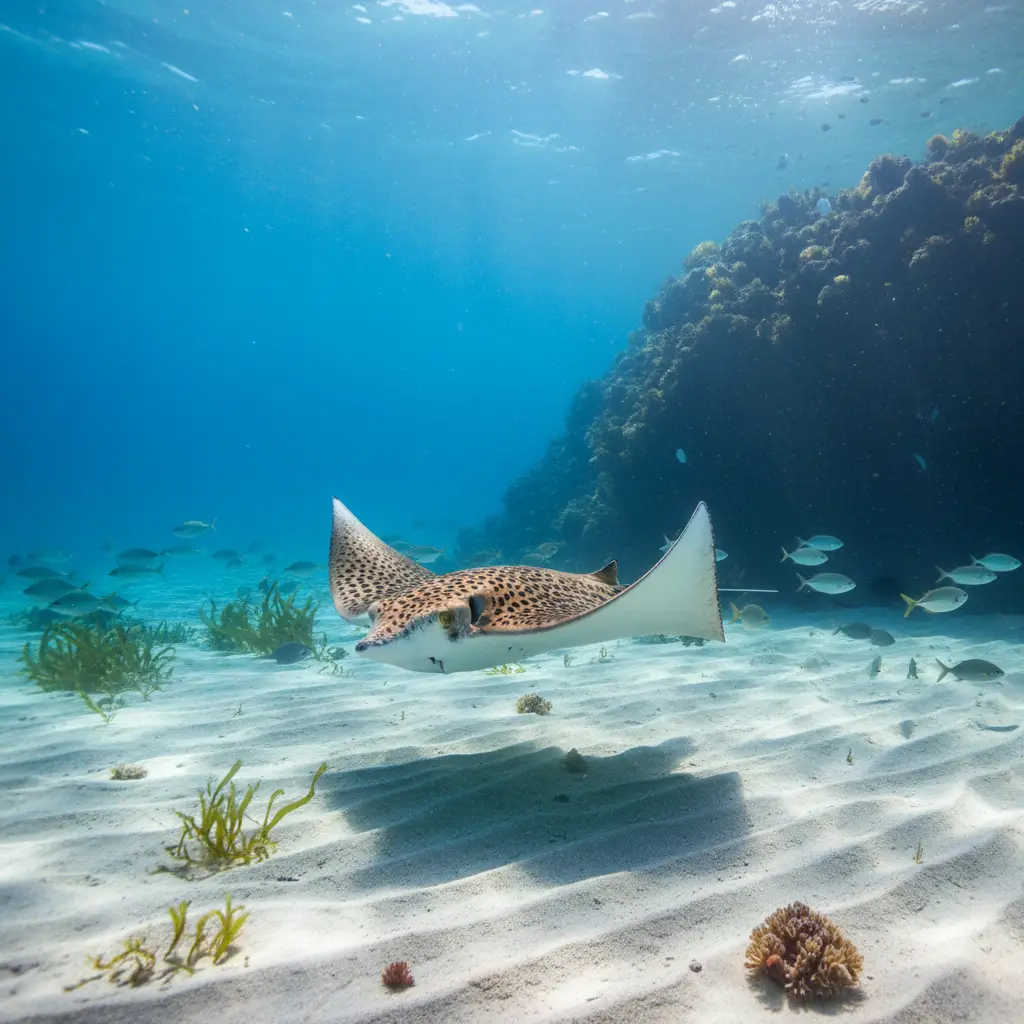
Eagle Rays are the aviators of the reef. They have distinct, pointed wings and a protruding head that resembles a bird’s beak. Their skin is dark brown/black with small blue or white spots. Unlike stingrays that rest on the bottom, Eagle Rays are often seen “flying” through the water column or digging vigorously in the sand with their snouts for shellfish.
Short-tailed Stingray (Whai)
These are the heavyweights. They have a round, disc-like shape and are often found resting motionless on the sandy floor, sometimes partially buried. In reserves like Goat Island, they can grow to immense sizes, with wingspans exceeding two meters. They are generally docile but should be treated with respect due to the barb on their tail.
Two-Spot Demoiselles: The Territorial Gardeners
As you move closer to the rocky reef structure, you will likely encounter clouds of small, feisty fish known as Two-Spot Demoiselles (Chromis dispilus). These are one of the few damselfish species found in New Zealand’s temperate waters.
Identification
Demoiselles are relatively small (up to 15-20cm). They are greyish-white with two distinctive white spots on their back, located near the dorsal fin. During mating season, the males’ behavior becomes frantic and aggressive as they guard their nests on the rock face. They will fearlessly charge at divers’ masks or cameras if they feel their territory is threatened.
Best Practices for Marine Observation
To get the most out of your species identification experience, follow these guidelines:
- Stay Calm and Still: Fish in marine reserves are curious, but rapid movements will startle them. Float on the surface or hover neutrally buoyant and let the fish come to you.
- Look in the Shadows: Many species, like the John Dory, Red Moki, and Moray Eels, prefer the shelter of kelp forests or rocky overhangs.
- Do Not Touch: Touching fish removes their protective slime coating, making them susceptible to infection. Furthermore, feeding fish (even in reserves where it might be technically legal in some specific spots, though generally discouraged) alters their natural behavior and diet.
- Use a Slate: Carry a waterproof ID slate or camera. It is much easier to identify a species once you are back on dry land if you have a reference photo or notes on fin placement and color.
Frequently Asked Questions
What is the most common fish in NZ marine reserves?
The most commonly sighted fish varies by region, but the Spotty (Paketi) and the Snapper (Tamure) are ubiquitous in most North Island marine reserves. In deeper waters or offshore reserves like the Poor Knights, Blue Maomao and Demoiselles are extremely abundant.
How can I tell the difference between a Trevally and a Kahawai?
Trevally have a higher, more compressed body shape with a silver sheen and a distinct black spot on the gill cover. Kahawai are more torpedo-shaped (streamlined) with intricate green/blue patterning on their backs and are generally faster swimmers.
Are there sharks in NZ marine reserves?
Yes, several shark species inhabit NZ marine reserves, including Bronze Whalers and Carpet Sharks. They are generally not aggressive toward divers. The Seven-gill shark is a notable resident in deeper southern reserves like Fiordland.
Why are the fish so big in Goat Island Marine Reserve?
Goat Island was established as a no-take marine reserve in 1975. This protection has allowed resident fish, particularly Snapper and Crayfish, to live their full natural lifespans and grow to maximum sizes without the pressure of fishing.
What is the best time of year for fish identification in NZ?
Late summer and autumn (February to May) offer the warmest water temperatures and generally the best visibility. This is also when many subtropical visitors and larval fish appear, increasing the diversity of species you might spot.
Can I feed the fish to get them closer for identification?
While fish feeding is not illegal in all reserves, it is strongly discouraged by the Department of Conservation. Feeding creates unnatural behaviors, dependency, and can make fish aggressive. In reserves, fish are naturally curious and will come close without food.