
Common jellyfish types in New Zealand include the Blue Bottle (Portuguese Man o’ War), Lion’s Mane, and Moon Jellyfish. Frequently confused with jellyfish, Salps are harmless clear blobs often found in chains. While most local species cause mild irritation, Blue Bottle stings require specific treatment using hot water immersion, not vinegar.
What are the different jellyfish types in NZ?
New Zealand’s diverse coastline, ranging from the sub-tropical north to the sub-antarctic south, hosts a fascinating array of gelatinous marine life. For marine tourists, swimmers, and divers, distinguishing between a harmless gelatinous blob and a stinging creature is essential for a safe beach experience. While the waters of Aotearoa are generally safe compared to the box-jellyfish-infested waters of tropical Australia, we do possess species capable of inflicting painful stings.
The term “jellyfish” is often used loosely to describe several different types of marine animals. In New Zealand, you will primarily encounter three categories: Scyphozoa (true jellyfish), Hydrozoa (like the Blue Bottle), and Tunicata (Salps). Understanding the physical characteristics of these groups is the first step in beach safety.
The Great Confusion: Salps vs. Jellyfish
What are those clear jelly blobs on the beach?
Every summer, New Zealand beaches—particularly in the Hauraki Gulf and Northland—are inundated with millions of clear, barrel-shaped organisms. These are almost always Salps, not jellyfish. For the uninitiated tourist, walking into water filled with these can be terrifying, but they are completely harmless.
Salps are Tunicates, a group of marine invertebrates that are actually more closely related to humans taxonomically than they are to jellyfish. They possess a primitive nervous system and a notochord during their larval stage. Unlike jellyfish, Salps have no stinging cells (nematocysts).
How to identify a Salp
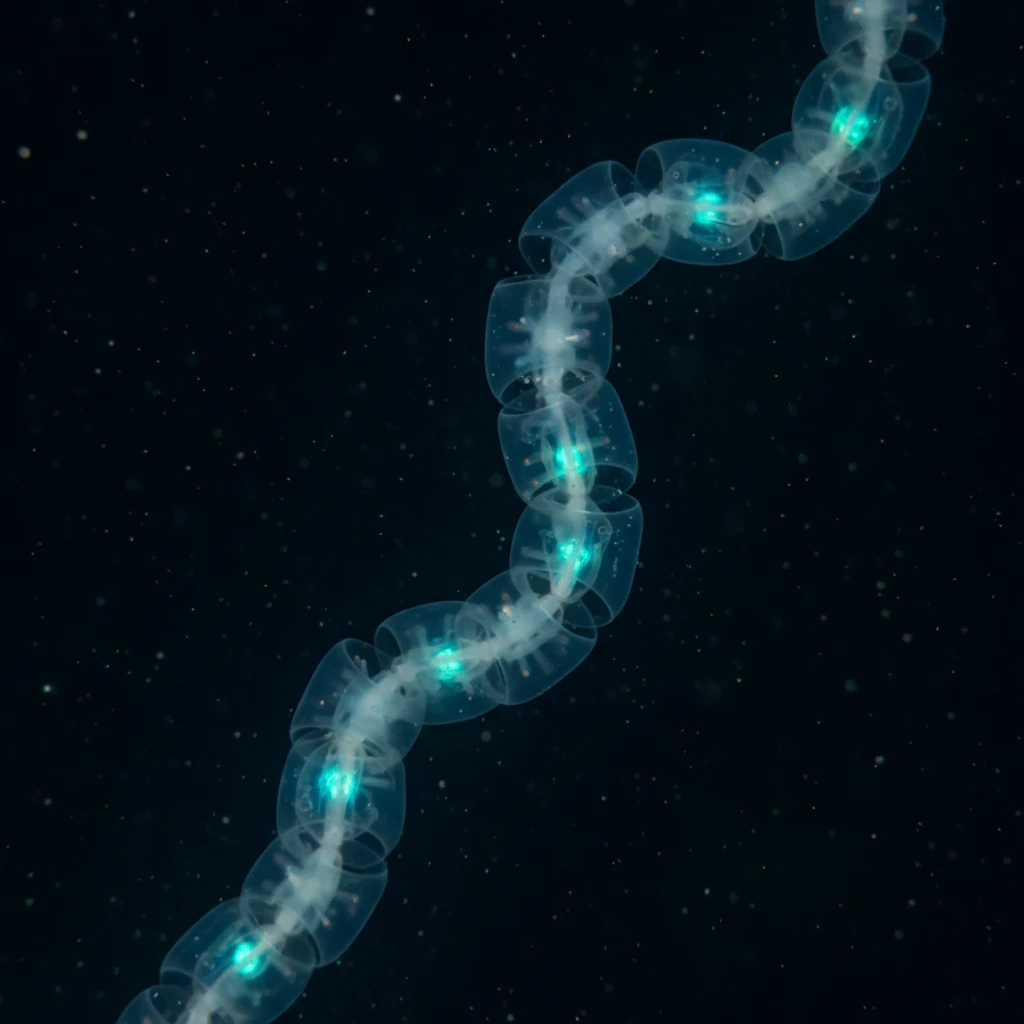
Salps move by pumping water through their gelatinous bodies, which also allows them to feed on phytoplankton. You will typically see them in two forms:
- Solitary: Individual barrel-shaped clear blobs, usually 1 to 10 cm long.
- Colonial: Long chains or snakes of attached individuals, sometimes reaching several meters in length.
If you touch a Salp, it feels firm and slightly slimy, similar to a peeled grape. It will not sting. Their presence is actually a sign of a healthy ecosystem, as they sequester massive amounts of carbon.
The Blue Bottle (Portuguese Man o’ War)
Is the Blue Bottle a true jellyfish?
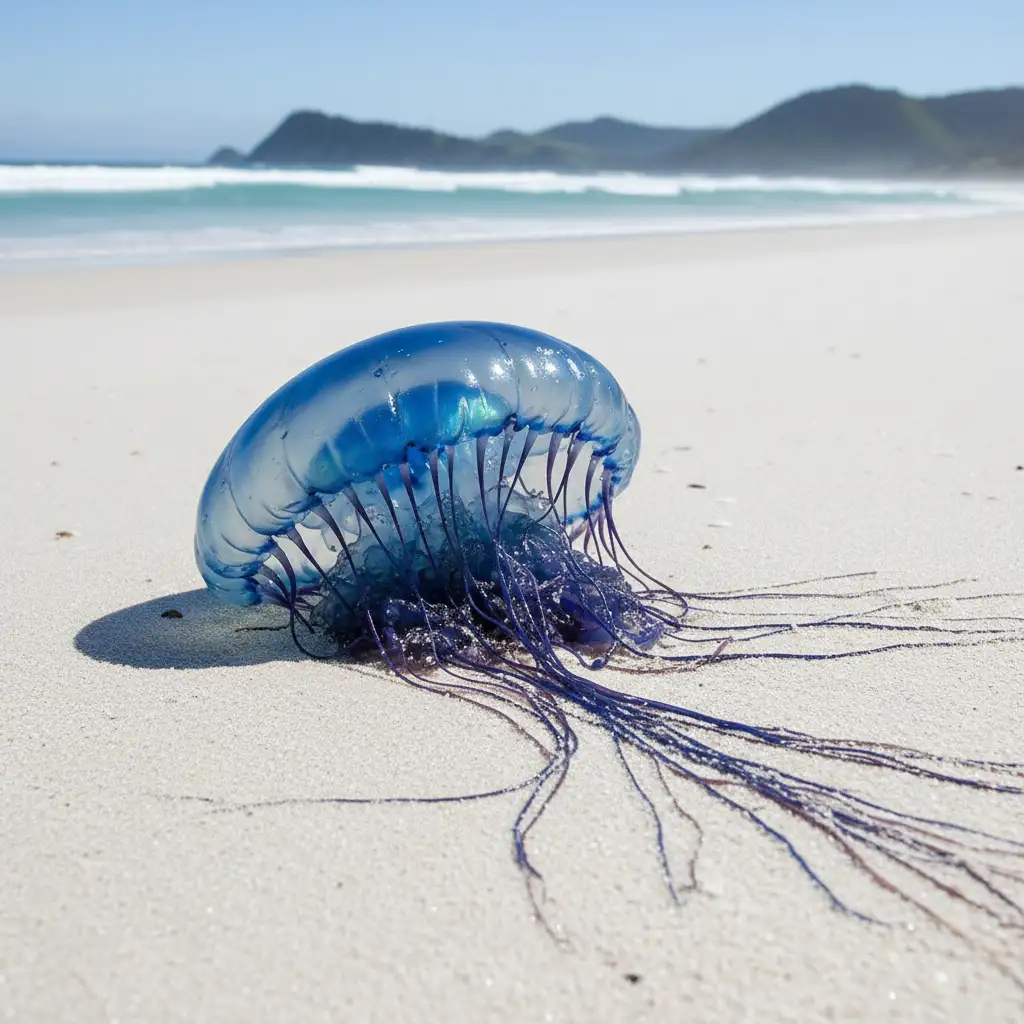
The most infamous stinger in New Zealand waters is the Blue Bottle (Physalia physalis). Technically, it is not a jellyfish but a siphonophore—a colony of specialized polyps working together as a single organism. They are most common on the east and west coasts of the North Island, often brought to shore by strong onshore winds.
Identification and Danger Level
The Blue Bottle is easily recognized by its gas-filled float (pneumatophore), which sits above the water surface like a small blue sail. This float can be up to 15cm long. Beneath the surface, however, trails a long, fishing tentacle that can extend up to 10 meters on mature specimens, though 1 to 3 meters is more common in NZ varieties.
The sting of a Blue Bottle is immediate and painful. The tentacles are lined with microscopic harpoons that inject venom upon contact. While rarely life-threatening to healthy adults, the pain can be excruciating, causing whip-like red welts on the skin. Systemic reactions can occur in children or those with allergies, leading to nausea or groin pain (due to lymph node processing of the venom).
The Lion’s Mane Jellyfish
How big do Lion’s Mane jellyfish get in NZ?
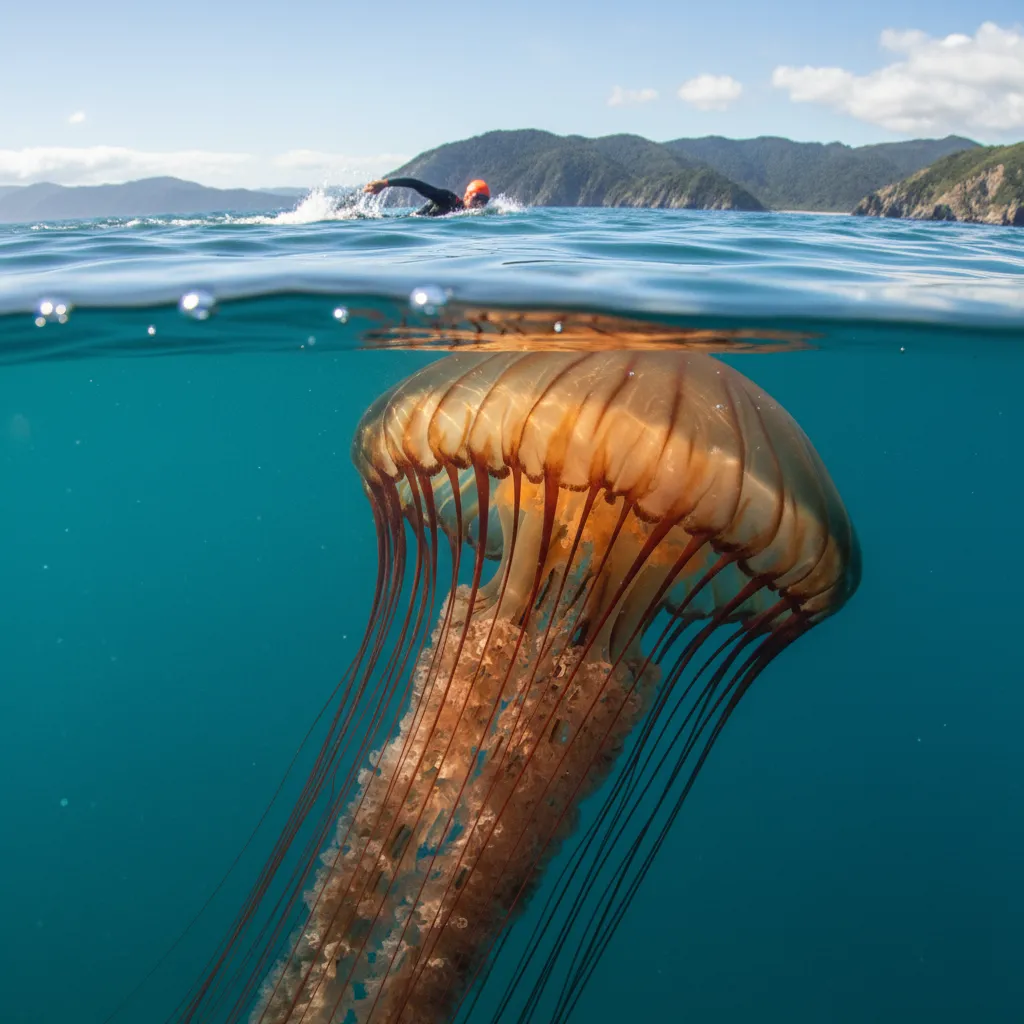
The Lion’s Mane (Cyanea rosea or Cyanea capillata) is the largest jellyfish species found in New Zealand waters. While they don’t reach the monstrous sizes of their Arctic cousins, NZ specimens can still have a bell diameter of 50cm and tentacles trailing over 2 meters.
Physical Characteristics
These true jellyfish are usually shaped like a saucer or a mushroom cap. Their color ranges from a deep pinkish-purple to a muddy brown or yellow. Beneath the bell, there is a thick mass of oral arms and hundreds of fine, hair-like tentacles organized in clusters. This “mane” of tentacles gives them their name.
Lion’s Manes are typically found in harbors, quiet bays, and around wharves. Unlike the Blue Bottle, they are strong swimmers and are not reliant on the wind. Their sting is generally considered less painful than a Blue Bottle’s but can still cause a burning sensation, rash, and localized blistering. Because they have so many tentacles, a swimmer who runs into one often gets stung over a large surface area.
Moon Jellyfish (Aurelia)
Are Moon Jellyfish dangerous?
The Moon Jellyfish (Aurelia aurita) is the most gentle of the common NZ species. They are saucer-shaped, transparent, and easily identified by the four distinctive purple or white rings (gonads) visible in the center of their bell.
Moon Jellies are ubiquitous in New Zealand, often seen pulsing gently near the surface of calm waters. Their sting is so mild that most humans cannot feel it, as their nematocysts are not strong enough to penetrate thick skin. You might feel a slight prickly sensation if you touch them with sensitive skin (like the face or inner arm), but they are generally considered harmless to swimmers and divers.
Understanding Seasonal Blooms
When is jellyfish season in New Zealand?
Jellyfish and Salp blooms are highly seasonal and weather-dependent. In New Zealand, the peak season typically runs from late spring (November) through to early autumn (March). This coincides with the warming of the water and the increase in plankton levels, which provides food for these organisms.
The “Smack” Phenomenon: A group of jellyfish is called a bloom, swarm, or smack. Blooms occur when ocean currents, nutrients, sunshine, and temperature align to boost the reproductive cycle. In recent years, warmer sea temperatures associated with La Niña weather patterns have led to larger and more frequent blooms in the Hauraki Gulf and Bay of Plenty.
For tourists, it is important to note that Blue Bottles are wind-driven. If there has been a strong easterly wind blowing for several days, east coast beaches (like Mount Maunganui or Coromandel) are likely to have Blue Bottles washed up on the sand. Conversely, calm, flat days are when you are more likely to encounter Lion’s Manes and Moon Jellies cruising the shallows.
How to Treat Jellyfish Stings in NZ
There is a significant amount of folklore surrounding jellyfish stings, particularly the myth that one should urinate on a sting. Do not do this. It is ineffective and unhygienic. Furthermore, the treatment for New Zealand jellyfish (Blue Bottles) differs from the treatment for tropical Box Jellyfish found elsewhere.
Step-by-Step Treatment for Blue Bottle Stings
Since Blue Bottles are the most common cause of stings in NZ, follow these guidelines recommended by the New Zealand Ministry of Health and St John NZ:
- Safety First: Get the patient out of the water immediately to prevent drowning or further stinging.
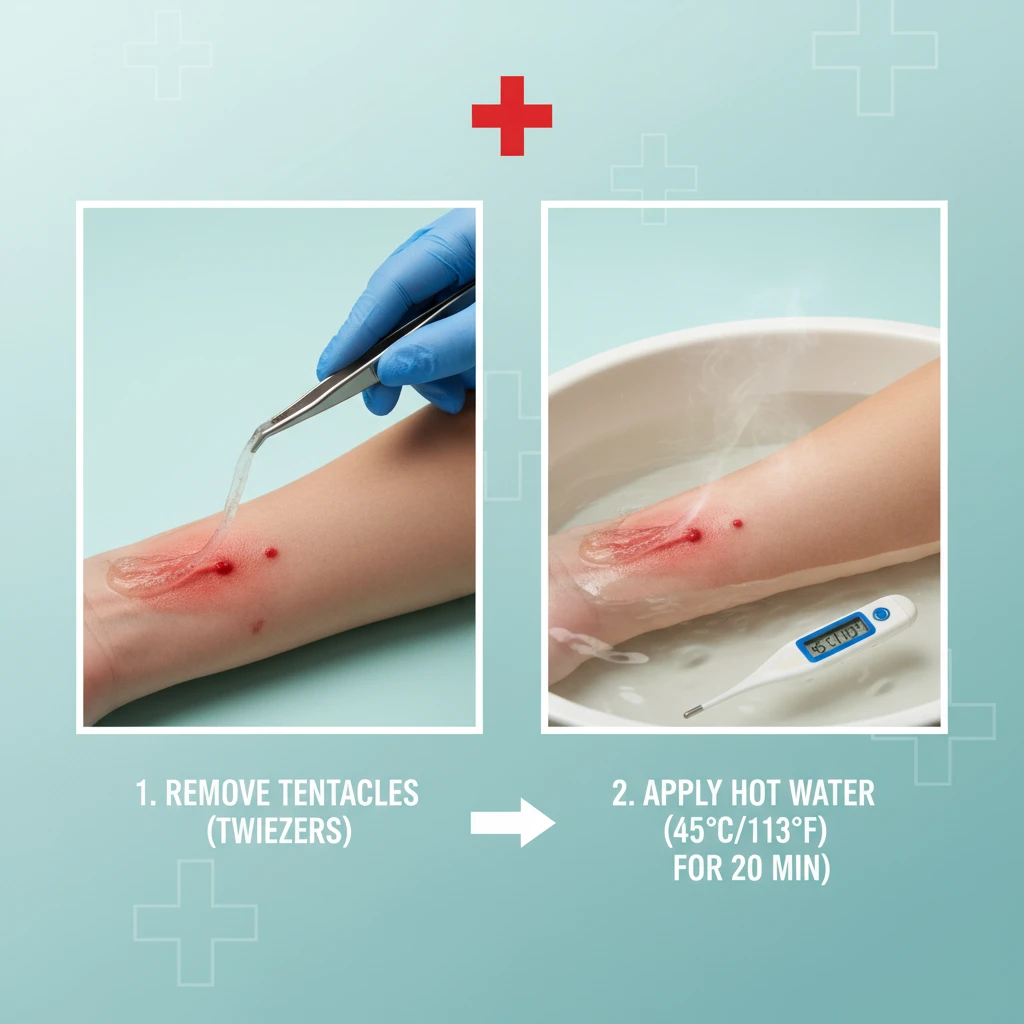
- Remove Tentacles: Do not rub the area, as this will trigger more venom release. Pluck off any visible tentacles using tweezers, a towel, or gloved hands. If you use bare fingers, you will be stung on your fingers.
- No Vinegar: Do not use vinegar on Blue Bottle stings. Vinegar can cause the nematocysts of Physalia species to fire, increasing the pain. (Note: Vinegar is used for tropical Box Jellyfish, but those are rare in NZ).
- Heat is Best: Immerse the stung area in hot water (approx. 45°C or as hot as can be tolerated without burning) for 20 minutes. The heat breaks down the protein-based venom and provides significant pain relief.
- Cold Pack: If hot water is unavailable, use a cold pack or ice wrapped in a cloth to numb the pain until you can get to hot water.
Treating Other Jellyfish Stings (Lion’s Mane)
For Lion’s Mane stings, the treatment is similar. Remove the tentacles carefully and rinse with seawater (not fresh water, which can trigger stinging cells). Immersion in hot water is the gold standard for pain relief for most marine envenomations in New Zealand.
When to seek medical attention
While most stings are manageable at the beach, call 111 (Emergency) if the person:
- Shows signs of anaphylaxis (swelling of face/lips, difficulty breathing).
- Has been stung over a large area (more than half a limb).
- Has been stung in the eye or mouth.
- Is a young child or elderly and appears unwell.
Summary for Marine Tourists
New Zealand’s waters are teeming with life, and encountering jellyfish is often part of the experience. By learning to identify the harmless Salps and Moon Jellies from the stinging Blue Bottles and Lion’s Manes, you can swim with confidence. Always scan the high-tide line before entering the water; if you see Blue Bottles on the sand, they are likely in the water too. Carry a thermos of hot water if you are planning a beach day in remote areas, and enjoy the incredible marine biodiversity Aotearoa has to offer.
Are there deadly jellyfish in New Zealand?
Generally, no. New Zealand does not have the lethal Box Jellyfish or Irukandji found in tropical Australia. While Blue Bottle and Lion’s Mane stings are painful, they are extremely rarely fatal and usually only pose a serious threat to those with severe allergies.
What is the tiny jellyfish that bites in NZ?
Swimmers sometimes experience “sea lice,” which aren’t lice but microscopic larvae of jellyfish or thimble jellyfish. These can get trapped inside swimwear and cause an itchy rash known as “seabather’s eruption.” They are annoying but not dangerous.
Can you touch the top of a Blue Bottle?
While the blue float (pneumatophore) does not sting, it is risky to touch it. The stinging tentacles are attached directly to it, and handling the float often results in accidental contact with a tentacle. It is best to avoid touching them altogether.
Why are there so many jellyfish in NZ right now?
Jellyfish blooms are influenced by water temperature and ocean currents. Warm currents (like La Niña) bring nutrient-rich water, boosting plankton growth, which jellyfish feed on. Strong winds also push offshore colonies onto the beaches.
Do wetsuits protect against jellyfish stings?
Yes, a standard neoprene wetsuit or even a thin Lycra “stinger suit” or rash guard provides excellent protection. The stinging harpoons (nematocysts) of NZ jellyfish are generally too short to penetrate through the fabric.
How long does a Blue Bottle sting last?
The intense pain of a Blue Bottle sting usually peaks within 15 to 30 minutes and subsides after an hour or two, especially with hot water treatment. However, the red, itchy welts on the skin can last for several days or even weeks.