
What are the best NCEA marine biology resources in NZ?
The premier NCEA marine biology resources in NZ are centered at the Goat Island Marine Discovery Centre, offering tailored field trip programs aligned with NCEA Level 2 and 3 Biology standards. These resources provide students with hands-on ecological monitoring tools, access to the University of Auckland’s Leigh Marine Laboratory, and comprehensive data sets for analyzing intertidal zonation, animal behavior, and socio-scientific issues regarding marine conservation.
For New Zealand educators and Biology Heads of Department (HODs), securing high-quality, reliable field work locations is critical for student success. As we move into the late 2024 and 2025 academic years, the integration of Mātauranga Māori alongside Western science is no longer optional—it is a core requirement of the NCEA Change Programme. The Cape Rodney-Okakari Point Marine Reserve (Goat Island) remains the gold standard for marine education, offering a unique intersection of protected biodiversity, academic rigor, and accessible infrastructure.
Why Choose Goat Island for NCEA Biology?
Goat Island is not merely a beach; it is a living laboratory. Established in 1975 as New Zealand’s first marine reserve, it offers a baseline of ecological recovery that is unmatched elsewhere in the country. For Biology teachers planning NCEA assessments, this location provides consistent, high-density data that ensures students can successfully identify patterns and relationships.
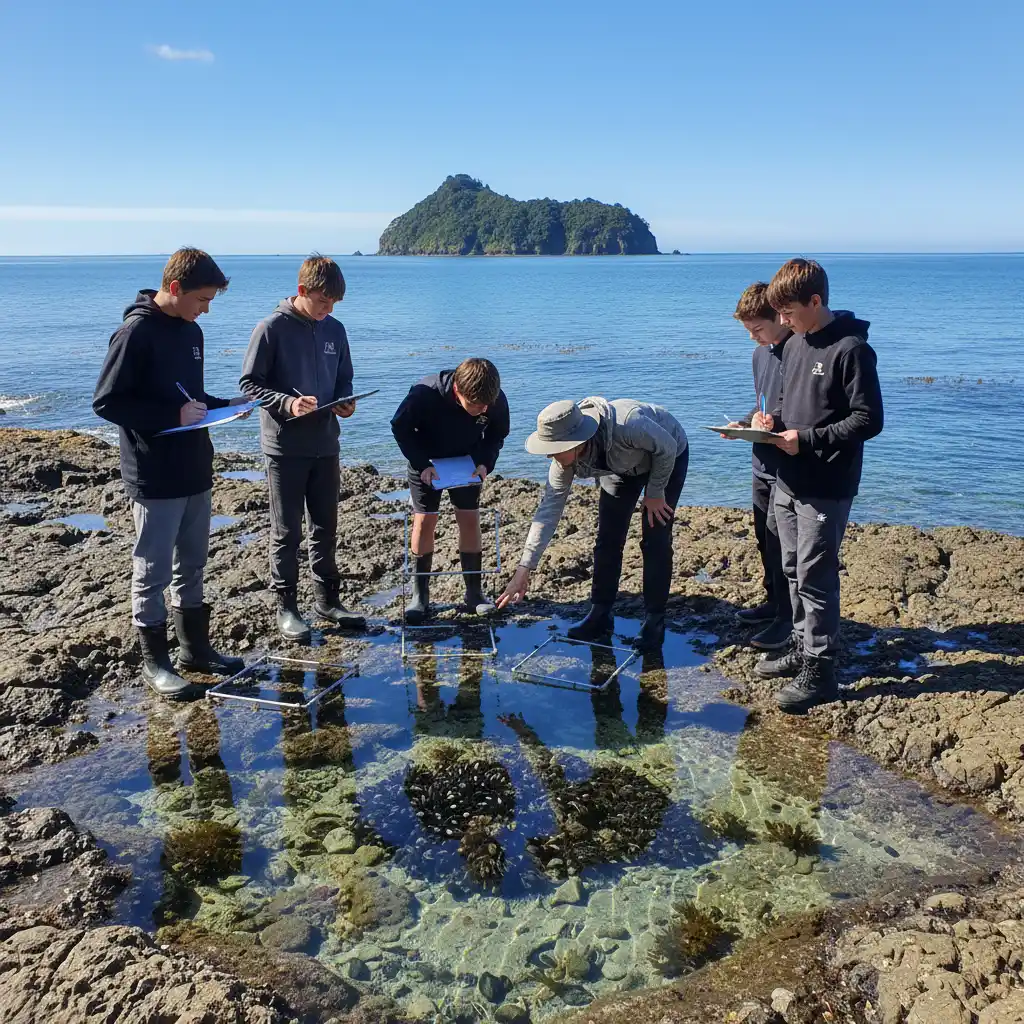
Unrivaled Biodiversity for Sampling
The primary challenge in NCEA Ecology standards (such as Biology 2.6) is finding an environment where stratification and zonation are clearly visible. In non-protected areas, overfishing and human disturbance often disrupt these natural patterns, leading to confusing data for students. At Goat Island, the trophic cascade is restored. Large predators like Snapper (Pagrus auratus) and Crayfish (Jasus edwardsii) control kina populations, allowing kelp forests (Ecklonia radiata) to thrive. This distinct zonation from the high tide mark to the sub-tidal zone provides textbook examples for transect studies.
University-Backed Education
Unlike standard outdoor education centers, the Goat Island Marine Discovery Centre is part of the University of Auckland’s Institute of Marine Science. This means the NCEA marine biology resources NZ educators access here are developed in consultation with active researchers. The educational programs are not static; they evolve to reflect current scientific understanding of climate change, ocean acidification, and marine protection efficacy, ensuring your teaching materials are accurate for the 2025 curriculum.
Curriculum Alignment (Level 2 & 3)
The educational officers at the Discovery Centre have tailored specific programs to meet the requirements of NCEA Biology achievement standards. Whether you are operating under the existing standards or transitioning to the new NCEA Level 2 specifications, the site offers versatility.
Level 2 Biology: Ecological Communities
The rocky shore at Goat Island is the ideal setting for AS91158 (Biology 2.6): Investigate a pattern in an ecological community. The Discovery Centre provides:
- Transect and Quadrat Equipment: Professional-grade gear is available, reducing the logistical burden on schools to transport equipment.
- Identification Guides: Region-specific guides that help students distinguish between key indicator species like *Hormosira banksii* (Neptune’s Necklace), Barnacles, and various gastropods.
- Data Analysis Support: Educators assist students in understanding the abiotic factors—desiccation, temperature, and salinity—that drive the zonation patterns observed on the shore.
Additionally, for AS91153 (Biology 2.1), which involves practical investigations, the controlled environment allows students to observe organism adaptations in real-time without the ethical concerns of disturbing unprotected ecosystems.

Level 3 Biology: Socio-Scientific Issues
For Level 3 students, the focus shifts to complex biological processes and societal impacts. Goat Island is the perfect case study for AS91602 (Biology 3.2): Integrate biological knowledge to develop an informed response to a socio-scientific issue.
The