NCEA Level 2 Biology worksheets for marine studies are specialized educational resources designed to support Achievement Standard 91158. These comprehensive guides facilitate student learning through structured field data collection, species identification, and the analysis of biological patterns like zonation and stratification in New Zealand’s intertidal rocky shore ecosystems.
For New Zealand educators and marine tourism operators hosting school groups, providing high-quality NCEA level 2 biology worksheets marine resources is essential for student success. Whether your class is visiting a marine reserve or conducting a local rocky shore investigation, having structured workbooks ensures that students capture the necessary data to investigate patterns in an ecological community. This guide outlines the essential components of effective teacher resources, from field data collection templates to raw datasets for classroom analysis.
What Should Be Included in Student Workbooks for Field Data Collection?
When designing or selecting student workbooks for field trips, the primary goal is to minimize cognitive load during the chaotic environment of a field study while maximizing data integrity. The worksheets must directly align with the requirements of AS91158: Investigate a pattern in an ecological community.
Structuring the Transect Data Tables
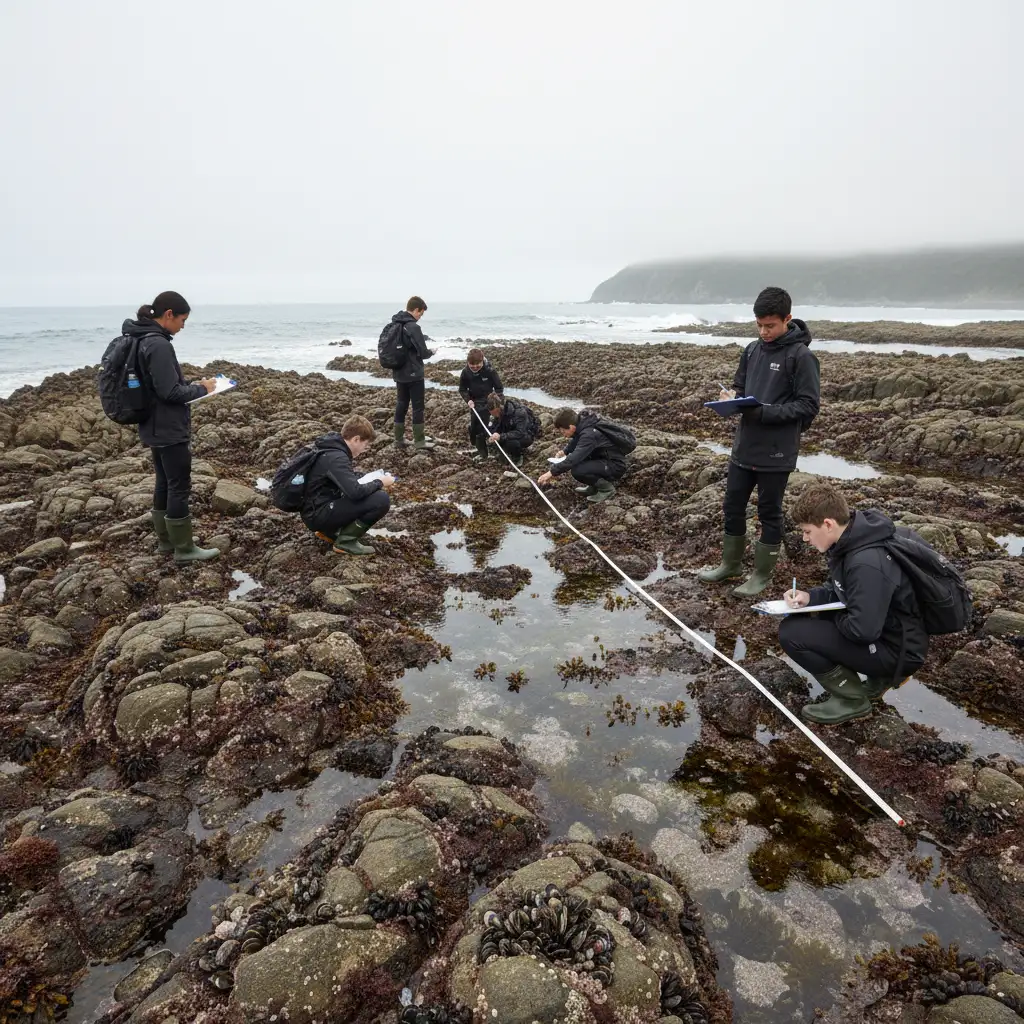
The core of any marine biology worksheet is the transect data table. Students are often required to investigate zonation, which necessitates recording species distribution relative to the distance from the low or high tide mark. An effective worksheet must include pre-formatted tables that prompt students to record:
- Distance/Height: Clearly labeled columns for meters along the transect line.
- Quadrat Number: To ensure replication is tracked.
- Species Count/Cover: Space to record abundance (percentage cover for sessile organisms like barnacles or algae, and individual counts for mobile species like chitons or gastropods).
- Substrate Type: Essential for analyzing abiotic factors.
Providing a template that separates these variables prevents students from collecting “messy” data that becomes unusable back in the classroom. For example, a well-structured table might look like this:
| Distance (m) | Quadrat # | Abiotic Factors (Temp, Light, Substrate) | Species A (Count/%) | Species B (Count/%) |
|---|---|---|---|---|
| 0m | 1 | … | … | … |
Recording Abiotic Factors
To achieve Merit or Excellence in NCEA Level 2 Biology, students must relate the biological pattern to environmental factors. Your worksheets must dedicate specific sections to measuring abiotic variables at each sampling point. Key variables include:
- Desiccation Stress: Often measured by distance from the low tide mark or exposure time.
- Temperature: Air and water temperature readings.
- Substrate Stability: Distinguishing between solid rock, boulders, cobbles, and sand.
- Wave Action: Qualitative observations of surge and exposure.
Ensure the workbook prompts students to explain how they measured these factors, as validity of method is a component of the investigation.
How to Use Raw Dataset Downloads for Classroom Analysis?
Not every class can make it to the rocky shore due to weather, budget, or logistical constraints. In these instances, raw dataset downloads act as a critical failsafe. These datasets simulate the results of a field trip, allowing students to process valid data without stepping foot on the beach.

Simulating Zonation Patterns
High-quality raw datasets should reflect realistic ecological patterns found in New Zealand marine reserves. When sourcing or creating these datasets for your students, ensure they show clear zonation patterns, such as:
- High Tide Zone: High abundance of Periwinkles (Austrolittorina antipodum) and Barnacles, with high resistance to desiccation.
- Mid Tide Zone: Dominance of Neptune’s Necklace (Hormosira banksii) and Tube Worms.
- Low Tide Zone: Presence of Kelp (Ecklonia radiata) and greater biodiversity due to reduced environmental stress.
The datasets should be provided in CSV or Excel formats to allow students to manipulate the data, calculate averages, and generate kite diagrams—a standard requirement for visualizing zonation.
Incorporating Anomalies for Critical Thinking
Perfect data rarely exists in nature. Excellent educational datasets include slight anomalies or outliers. This forces students to engage in critical thinking. For example, a dataset might show a sudden drop in barnacle population in the high tide zone where a rock pool exists. This allows students to discuss microclimates and how they disrupt general zonation patterns, a discussion point that often elevates a grade from Achieved to Merit.
Which Species Identification Guides Are Best for Students?
Accurate identification is the prerequisite for any valid ecological investigation. If a student cannot distinguish between a Blue Mussel and a Green-lipped Mussel, their pattern analysis will be flawed. Worksheets should be accompanied by robust identification guides tailored to the specific region (e.g., Northern vs. Southern NZ rocky shores).

Focusing on Indicator Species
Rather than a generic guide of all marine life, effective NCEA resources focus on indicator species that define the zones. Your identification resources should highlight:
- Structural Adaptations: Close-up images showing the operculum of gastropods (to prevent water loss) or the holdfasts of algae (to resist wave action).
- Ecological Niche: Brief descriptions of the organism’s feeding mode (grazer, filter feeder, predator) to help students discuss interrelationships.
- Physiological Tolerances: Notes on the species’ tolerance to salinity changes, temperature fluctuations, and desiccation.
Digital vs. Physical Guides
While physical, laminated guides are durable for field use, digital guides integrated into worksheets (via QR codes) allow students to access deeper biological information. For example, a QR code next to the Pied Shag entry on a worksheet could link to a video of its feeding behavior, aiding the discussion on interspecific relationships.
How to Structure Post-Trip Assessment Templates?
The post-trip assessment is where students synthesize their raw data into a cohesive biological report. Templates for this phase should scaffold the writing process without providing the answers, guiding students through the scientific method.

Scaffolding the Discussion of Adaptations
One of the most common pitfalls in NCEA Level 2 Biology is failing to link the pattern to the biology of the organism. Assessment templates should include prompts such as:
- “Describe the pattern shown in your graph for Species X.”
- “Explain the structural, behavioral, or physiological adaptation that allows Species X to survive in this zone.”
- “Relate this adaptation to the specific abiotic factor (e.g., desiccation) present in this zone.”
Analyzing Interrelationships
To reach Excellence, students must discuss biological interrelationships (competition, predation, mutualism). Worksheets should explicitly ask for evidence of these interactions. For instance:
- Competition: “Why does the population of Barnacles decrease as the population of Oysters increases?” (Prompting a discussion on competition for space).
- Predation: “How does the distribution of the predator (e.g., Whelks) correlate with the distribution of the prey (e.g., Barnacles)?”
Validating the Investigation
Finally, a section on the validity and reliability of the data is crucial. Templates should ask students to reflect on their methodology. Questions might include: “How did you ensure your quadrat sampling was random?” or “What limitations did the weather impose on your data collection, and how might this affect your conclusion?” This encourages the critical evaluation required for higher marks.
By utilizing these structured NCEA level 2 biology worksheets marine resources, teachers can ensure their students are not only prepared for the field trip but are also equipped with the analytical tools necessary to excel in their internal assessments. Whether through physical workbooks or digital datasets, the key lies in clear, curriculum-aligned structure.
Frequently Asked Questions
What is the main focus of NCEA Level 2 Biology marine worksheets?
The main focus is to support Achievement Standard 91158 by guiding students in collecting and analyzing data to identify patterns (like zonation) in an ecological community and relating them to biotic and abiotic factors.
Can I use raw datasets instead of a field trip for AS91158?
Yes, while field trips are preferred for hands-on learning, valid raw datasets can be used for the assessment if they allow students to process data, identify patterns, and relate them to biological concepts.
What are the key abiotic factors to measure on a rocky shore?
Key abiotic factors include desiccation (exposure to air), temperature, light intensity, substrate type (rock, sand, mud), and wave action/exposure.
How do I ensure my marine biology worksheets are NCEA compliant?
Ensure they align with the NZ Curriculum Level 7 Biology strand and specifically address the criteria of AS91158, focusing on community patterns, environmental factors, and adaptations.
What is a kite diagram in the context of marine biology?
A kite diagram is a graphical representation used to show the distribution and abundance of species along a transect line, making it easy to visualize zonation patterns.
Where can I find species identification guides for NZ rocky shores?
Resources are available through the NZ Marine Studies Centre, Department of Conservation (DOC), and various educational publishers specializing in NCEA science resources.