The history of Goat Island Marine Reserve, officially known as Cape Rodney-Okakari Point Marine Reserve, began in 1975 as New Zealand’s first no-take marine sanctuary. Pioneered by Dr. Bill Ballantine, it transformed from an overfished ecosystem into a thriving underwater forest, setting a global precedent for marine conservation and proving the ecological value of strictly protected areas.
The Establishment: A Global First (1975)
The establishment of the Cape Rodney-Okakari Point Marine Reserve, colloquially known as Goat Island, marks a watershed moment in the history of global marine conservation. Before 1975, the concept of a “no-take” marine reserve—an area where all fishing and extraction are strictly prohibited—was virtually unheard of in New Zealand and rare internationally. The ocean was widely viewed as an inexhaustible resource, and the idea of restricting public access to fishing grounds was met with significant skepticism and hostility.
The journey to protection began in 1965, driven not initially by conservationists, but by scientists. The University of Auckland had established the Leigh Marine Laboratory nearby and required an undisturbed environment for scientific study. Researchers found their experiments constantly compromised by recreational and commercial fishing activities. It became clear that to understand the natural baseline of the ocean, a control area was needed—a laboratory in the wild.
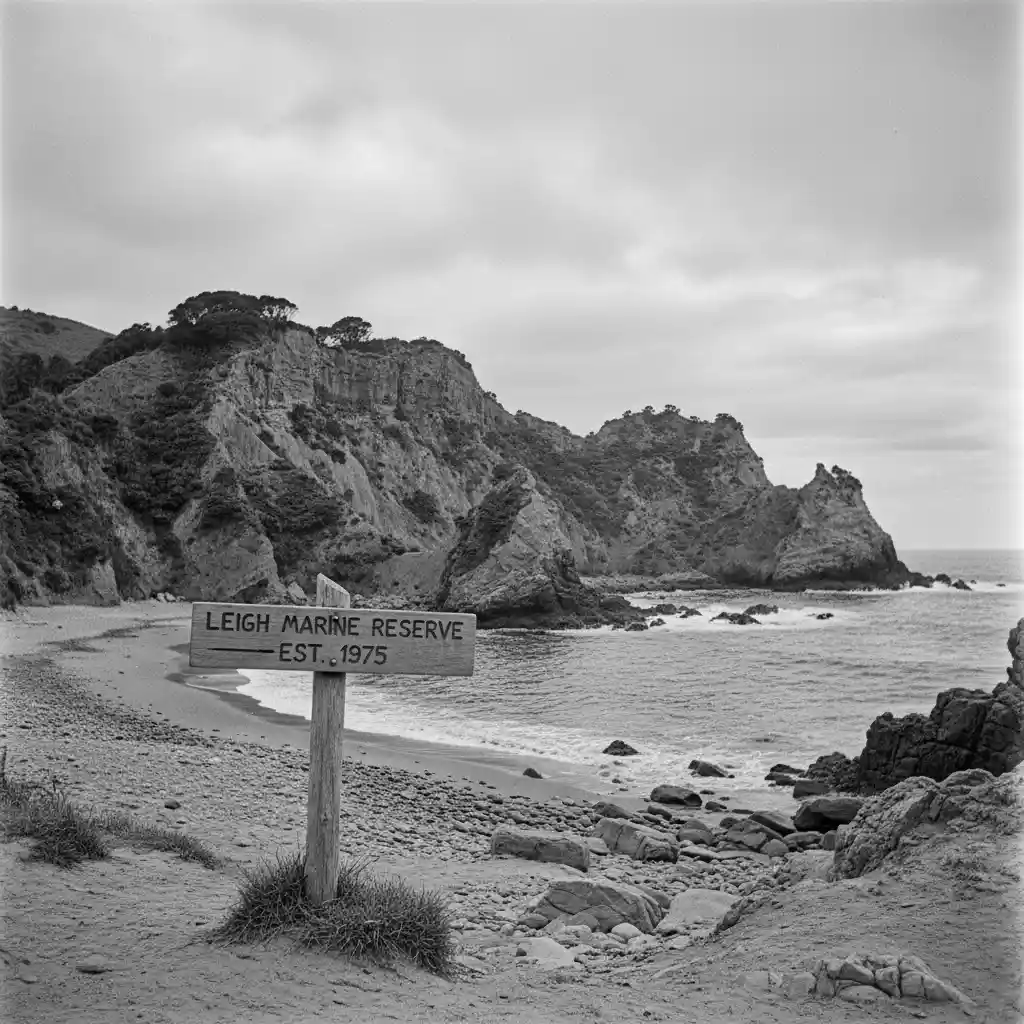
However, the legislative framework to create such a sanctuary did not exist. It took a decade of lobbying, public meetings, and political maneuvering to pass the Marine Reserves Act in 1971. Even after the Act was passed, it took another four years to officially gazette the Cape Rodney-Okakari Point Marine Reserve in 1975. At the time of its opening, the reserve covered 518 hectares of coastal sea. It was a controversial experiment, with local fishermen fearing it would ruin their livelihoods. Contrary to these fears, the reserve would eventually become the most productive biological asset in the region.
Dr. Bill Ballantine: The Father of Marine Reserves
No history of Goat Island is complete without discussing the monumental legacy of Dr. Bill Ballantine (1937–2015). A British-born marine biologist, Ballantine arrived at the Leigh Marine Laboratory in the 1960s and became the driving force behind the reserve’s creation. He is widely regarded as the “father of marine reserves” in New Zealand and a seminal figure in global marine science.
The Philosophy of No-Take
Dr. Ballantine’s philosophy was simple yet revolutionary: you cannot manage what you do not understand, and you cannot understand the ocean if you kill everything in it. He argued that without fully protected areas, humanity had no baseline to measure the impacts of fishing. He famously compared managing the ocean without reserves to “running a library where you burn the books to keep warm.”
Ballantine faced intense opposition. Recreational anglers and commercial fleets viewed the ocean as a commons where freedom to fish was a birthright. Ballantine spent years attending town hall meetings, often facing angry crowds, to explain that a reserve would essentially act as a “savings bank” for the ocean, where the interest (larvae and spillover fish) could be harvested, but the capital (the breeding stock inside the reserve) remained untouched.
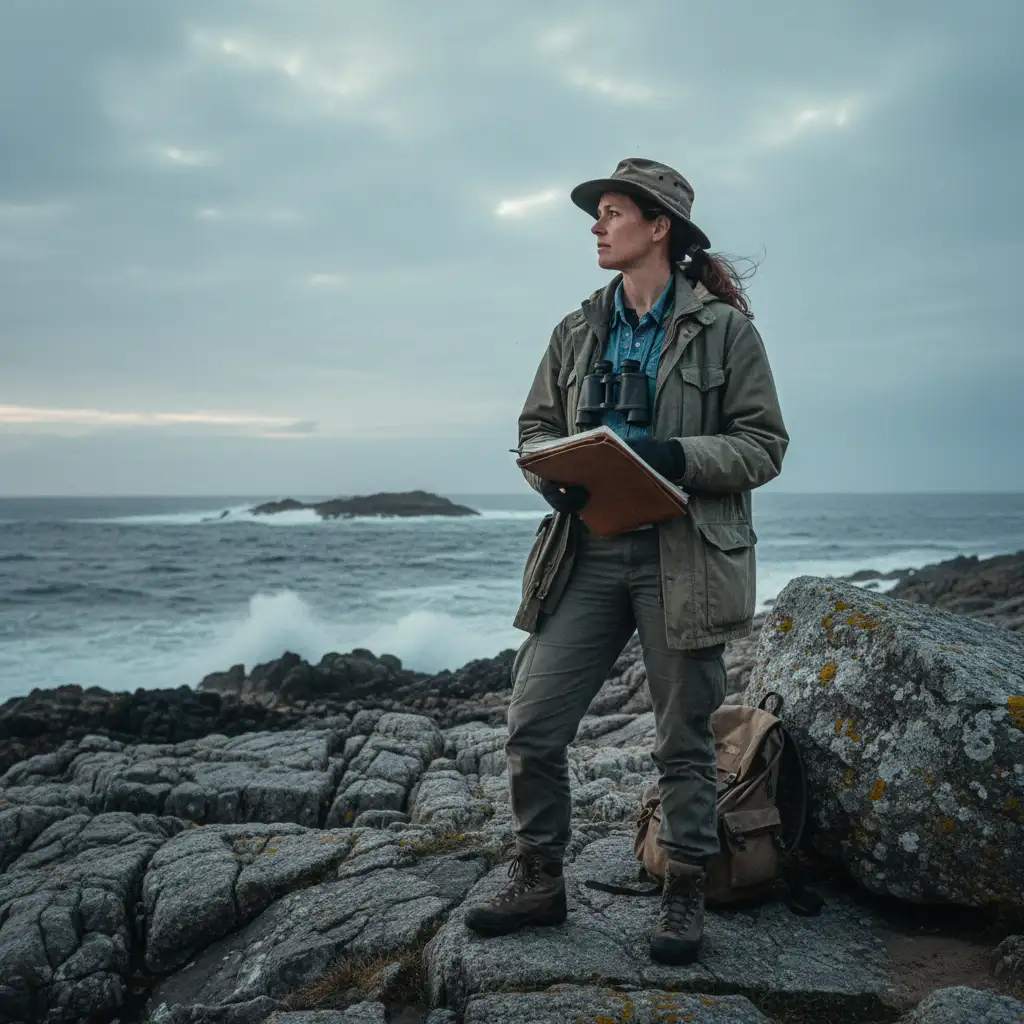
His persistence paid off. Following the success of Goat Island, Dr. Ballantine campaigned tirelessly for a network of reserves across New Zealand. His work laid the foundation for the establishment of over 40 marine reserves in the country today. His legacy lives on not just in the legislation, but in the thriving ecosystems that have recovered due to his vision.
Motu Hāwere: Māori History and Significance
While the “Marine Reserve” history dates back to 1975, the human history of the area extends back nearly a millennium. To the local iwi (tribe), Ngāti Manuhiri, the island is known as Motu Hāwere. The area holds immense spiritual and cultural significance (mana) and has been a source of sustenance (kaimoana) for generations.
Motu Hāwere was not just a fishing ground; it was a strategic location. The island itself provided shelter for waka (canoes) traveling along the coastline. The name “Goat Island” is a colonial moniker, likely derived from the early practice of European sailors releasing goats on islands to provide food for future castaways or passing ships, although the island is currently goat-free and a sanctuary for seabirds.
The relationship between the Marine Reserve status and Māori customary rights has been complex. The establishment of the reserve meant a suspension of customary fishing rights in that specific area. However, Ngāti Manuhiri have played a crucial role as kaitiaki (guardians) of the coastline. In recent years, the partnership between the Department of Conservation and Mana Whenua has strengthened, ensuring that the history of Motu Hāwere is told holistically, honoring both the scientific achievements and the ancestral connection to the land and sea.
From Kina Barrens to Kelp Forests: The Ecological Recovery
The most dramatic chapter in the history of Goat Island Marine Reserve is the story of its biological recovery. When the reserve was established in 1975, the underwater landscape looked vastly different from what visitors see today. Decades of overfishing had removed the large predators, specifically Snapper (Tāmure) and Crayfish (Kōura).
The Trophic Cascade
Without these predators to keep their populations in check, the Kina (sea urchin) population exploded. Kina are voracious grazers of kelp. By the 1970s, the seafloor at Goat Island was largely a “Kina barren”—a rocky desert devoid of seaweed forests, offering little shelter for other marine life. This phenomenon is known as a trophic cascade.
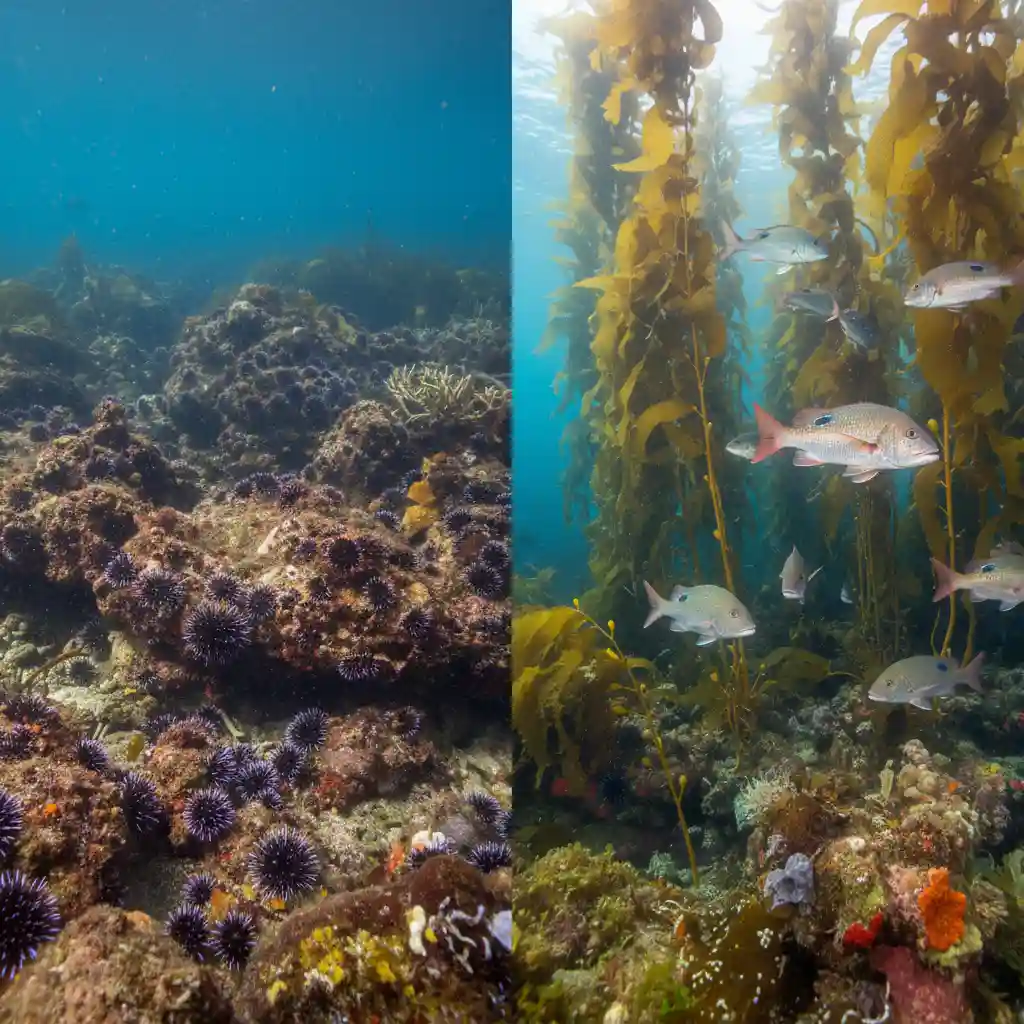
Following the protection in 1975, the ecosystem began a slow but miraculous recovery:
- 1975-1985: Fishing ceased. Slowly, snapper and crayfish populations began to stabilize, though recovery was not immediate.
- 1985-1995: Large predators returned. Snapper, which can live for over 60 years, grew to sizes rarely seen outside the reserve. Large crayfish re-emerged from crevices.
- 1995-Present: The predators began consuming the Kina. With the urchin population controlled, the Kelp forest regenerated.
Today, the reserve is characterized by dense forests of Ecklonia radiata (kelp). This habitat complexity supports a massive diversity of life, including sponges, anemones, and schools of plankton-eating fish like Demoiselles and Blue Maomao. The history of the reserve provides the clearest scientific evidence in New Zealand of how marine ecosystems function when left undisturbed.
The Scientific Impact: Proving the Spillover Effect
The history of Goat Island is also the history of marine science validation. For years, critics argued that reserves simply locked away resources. However, studies conducted at the Leigh Marine Laboratory using Goat Island as a primary data source proved the existence of the “Spillover Effect.”
Scientists discovered that as the density of fish inside the reserve reached carrying capacity, fish migrated past the boundaries into the surrounding waters. Furthermore, the large, old snapper protected within the reserve were found to be exponentially more valuable breeders. A single large snapper can produce the same amount of eggs as dozens of smaller, legal-sized fish.
Consequently, the “history” of the reserve includes a shift in local attitudes. Commercial crayfish potters began setting their traps right along the boundary lines of the reserve, recognizing that the catch rates near the sanctuary were significantly higher than elsewhere. The reserve had transformed from a controversial restriction into a biological engine that replenished the surrounding fishery.
The Evolution of Tourism and Education
In the late 1970s, Goat Island was a quiet spot known only to locals and scientists. Today, the history of the reserve has evolved into a narrative of tourism management. It attracts over 300,000 visitors annually, making it one of New Zealand’s premier eco-tourism destinations.
This popularity brought its own challenges. By the early 2000s, the sheer number of visitors threatened the ecosystem. People were feeding the fish (altering their natural behavior) and trampling the intertidal reefs. This necessitated a new phase in the reserve’s history: active visitor management.
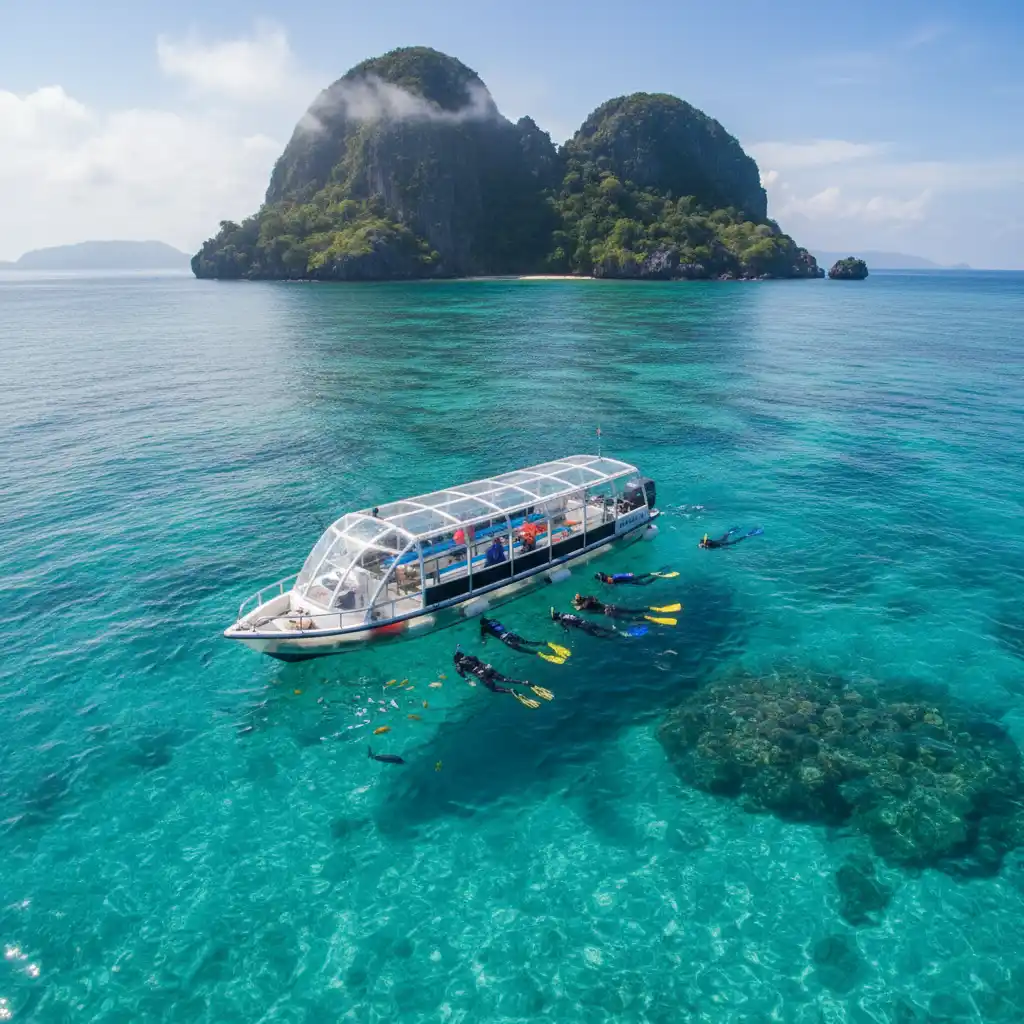
The establishment of the Goat Island Marine Discovery Centre by the University of Auckland helped pivot the focus toward education. Strict rules were enforced regarding fish feeding (now prohibited), and boardwalks were constructed to protect the dunes. The reserve now serves as a massive open-air classroom, educating thousands of school children every year about the importance of marine conservation.
The history of Goat Island Marine Reserve is a testament to the power of resilience—both of the ocean and of the visionaries who fought to protect it. It stands as a living museum, preserving a glimpse of what New Zealand’s oceans looked like before human impact.
Frequently Asked Questions
When was Goat Island Marine Reserve established?
Goat Island Marine Reserve was officially established in 1975, making it New Zealand’s first marine reserve. It was created following the passing of the Marine Reserves Act in 1971.
Why is it called Goat Island?
The name is a colonial holdover. Early European sailors often released goats on offshore islands to ensure a food source for shipwrecked survivors or future voyages. The island is known to Māori as Motu Hāwere.
Who was Dr. Bill Ballantine?
Dr. Bill Ballantine was a marine biologist at the Leigh Marine Laboratory who spearheaded the campaign to create the reserve. He is known as the “father of marine reserves” in New Zealand for his advocacy of no-take sanctuaries.
What is the “Spillover Effect” observed at Goat Island?
The Spillover Effect is the phenomenon where marine life, having reached high population densities within the protected reserve, migrates into the surrounding waters, thereby improving fishing opportunities outside the reserve boundaries.
Can you fish at Goat Island Marine Reserve?
No. It is a strictly “no-take” marine reserve. All fishing, gathering of shellfish, or disturbing of marine life is strictly prohibited and punishable by significant fines.
How has the ecosystem changed since 1975?
The ecosystem has recovered from a “kina barren” (urchin-dominated desert) to a flourishing kelp forest. The return of large predators like snapper and crayfish controlled the urchin population, allowing the seaweed forests to regrow.